



Offcuts: A Plane Tale By: Don Heisz
I really like hand planes. They are very satisfactory tools, when they work properly. Unfortunately, my first experiences of hand planes were discouraging.
I think the very first time I was given a hand plane to use was in my high school woodworking class. I may have mentioned before that the class was run by a lunatic. But, overly violent and unpredictable as he was, I assumed he knew what he was talking about. After all, he was the teacher.
“To glue up your two boards, you need to joint the edges to make sure there is no gap anywhere. You do that by lining up the two boards side-by-side and clamping them in the vise.”
As a demonstration, this was pretty good to watch. He took the two 3/4 inch boards and lined them up, clamped them in the vise. Everyone was sitting at their own bench, being more or less quiet. He didn’t react well to talking.
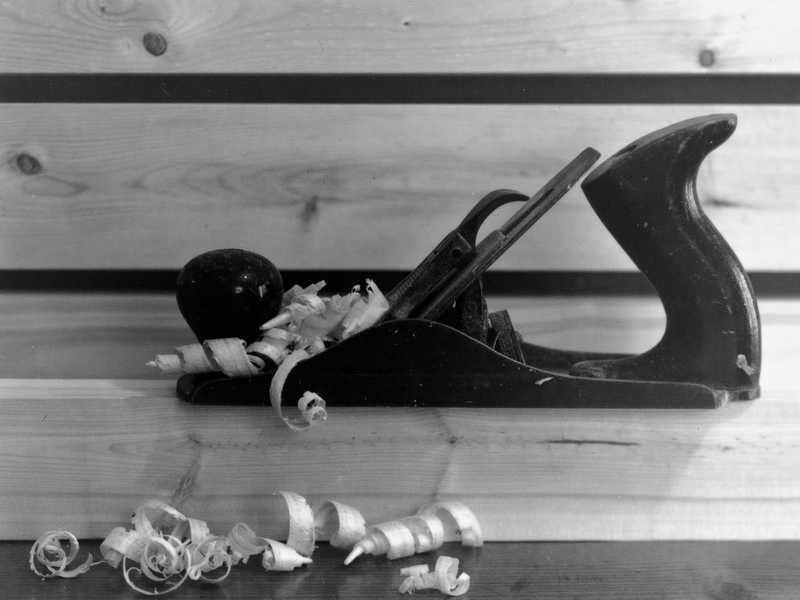
“Then you take your hand plane,” he held up a jack plane, which was the only kind of plane in the shop. “You set the blade to just a little depth…” He squinted at the blade sticking up from the bottom of the upside-down plane as he eyed up the depth and fiddled with the lever and knob. “Try to get the blade depth uniform.”
That, incidentally, was my second discouraging experience of hand planes. As one of my first woodworking purchases, I went out and bought a small block plane. However, not really having much of an idea what I should be getting, I got the least expensive (I also didn’t really have money for anything better). I discovered that the blade was quite dull, but I sharpened it easily enough. And then I discovered that the plane would produce exactly one uniform shaving, then it would start to produce tiny scrapings, then it would do nothing. The blade would not stay wedged, so it kept retracting into the plane body. I managed to get that to tighten up little bit, but then the blade would shift as I used it, so one side would be deeper, the other side would cut nothing.
I still have it. I think it’s buried under all the other junk in my shop.
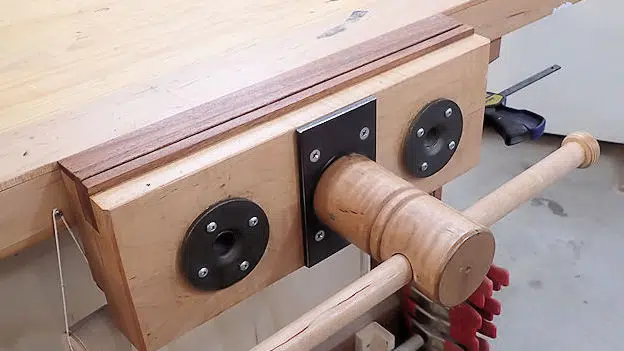
“Make sure the boards are nice and tight in the vise.” He gave the vise a crank that was probably hard enough to start to splinter the white pine he had in it. Everyone was rapt.
“Then you steadily plane the edge of both boards.”
He held the plane, left hand on the knob, right hand on the handle, and shoved it along the length of the boards. Or, rather, he tried to do that. The blade hit the corner and stopped.
He muttered something a teacher is not supposed to say in front of the class. Some people laughed. They stopped when he glared across the room.
“The blade might be a tad too deep,” he said, and he fiddled with the adjustment. Someone at the front of the class raised his hand. The teacher ignored him.
“Ok, so, nice and even,” he said, and we could see he was throwing the majority of his weight into the planning action. Slightly more success this time, the plane gouged out a chunk from the corner almost an 1/8 inch thick and an inch long before it stopped.
More muttering and fiddling with the blade followed. Then he pulled the boards out of the vise and flipped them around. “The grain can work against you,” he yelled, and twisted the vise handle almost hard enough to break it.
The boy at the front of the class still had his hand up.
“So, nice and even.” He planed the edge of the two boards. The plane very smoothly sailed along the length of the boards without doing anything. “Now there’s no blade sticking out,” he laughed. No one else laughed.
He adjusted the depth one more time and tried again. We could see determination radiate from him as he faced the wood and flung himself across it. The plane gouged out the edge the entire length of the boards, leaving a rough face and a splintered mess sticking out of the plane.
He tossed the plane into the garbage can and threw the boards across the room.
The boy at the front of the class later told me that he could see the blade was upside down.