



Offcuts: The Dresser By: Don Heisz
I’ve bought a few pieces of old furniture over the years. The first was a desk that had previously had its legs replaced by ready-made banister spindles. The top was made from plywood that was delaminating from water damage. That one was beyond redemption, but it was very nearly free. I was living in an apartment and only kept it for a year or so.
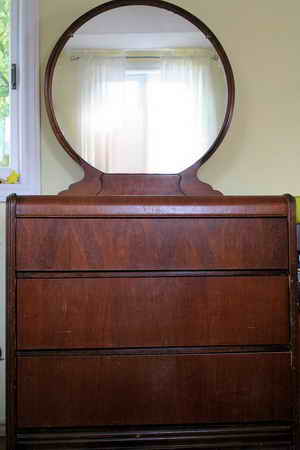
I have also bought several chairs and a couple of tables. A week or so ago, though, I bought an old dresser with a circular mirror that was probably made sometime between 1920 and 1940. It has all the proper characteristics of Art Deco styling. The materials are all solid wood and plywood. Veneers are bookmatched wherever possible. And the top features a rounded-over front known as a waterfall.
Just as so many other people have done, I immediately opened the drawers and examined the joining of the front to the sides. As anticipated, there are dovetails. However, these dovetails were hand-cut. I found that a little surprising. Whoever did it did a pretty good job.
I actually opened the drawers, though, to survey the damage done by time and use. As expected, the drawer bottoms looked pretty bad. Also expected, the glue had failed in the joints. Unfortunately, however, someone had tried to fix the drawers.
Fixing things is great. I am a firm believer in resurrecting the functionality of something by knocking in a few nails, driving a few screws, or squeezing a bit of glue. But I generally have some idea what I’m doing. For example, I know that plywood drawer bottoms don’t get glued into the dado. I know that you glue the sides of the drawer and pin the drawer bottom at the back of the drawer with some nails or staples. But the fearless handyman who previously had this dresser only saw that the bottom was falling out and the sides were coming apart.
The fact is, the bottoms of the drawers are made from the only material that failed over the life of the dresser. The hardwood plywood (seems to be maple) is thin at 3/16 of an inch. That’s actually quite strong, though. Certainly strong enough to hold up Aunt Petunia’s knickers. But the glue in the lamination failed. And what didn’t peel apart warped.
Ah, but glue fixes everything. So, the handyman takes his trusty bottle of carpenter’s glue (I’d recognize those yellow puddles anywhere) and glues everything he sees. Good as new. Oh, but it’s not square anymore. Darn.
I had no intention of restoring this dresser to some kind of like-new state. Luckily, there was enough thickness in the drawer sides to shave down to get close to square. But I can’t free the bottom without smashing the sides and destroying the lovely (so lovely) dovetails. Anyway, the original finish on the dresser was scuffed and scratched and dented and completely scraped off in places.
I fixed the finish by using some fine sandpaper in my palm sander and going over the whole thing. Some people would think that is not the right thing to do. You should strip the finish and redo it. I’d agree with that if I also liked having my toenails pulled out. Anyway, this isn’t a valuable antique, it’s just a piece of old factory-made furniture that might be able to look good and actually be somewhat functional.
So, after sanding the finish, I rubbed some walnut-coloured Danish oil on it. That soaked nicely into where the wood was bare from use and damage (such as, where the drawers scrape when opened) and polished up the remaining finish. It reinvigorated the bookmatched veneers of the drawer-fronts. However, I had a couple of problems with the top. The first problem was water-damage, which remained discoloured. The second problem was the fact that at some point someone was regularly waxing the top. During sanding, the old polish was turning into chewing gum under the paper. I could not get all of that off and the Danish oil only soaked into the water-damaged and scratched areas. The rest of it simply rubbed off. So, I finished it off with some furniture polish.
Perhaps this is simple barbarism to some people. And certainly many people would not consider it worthwhile. The drawer-bottoms, for instance, can’t be removed, but I can always cut some 1/4 inch hardboard to just drop in over the old plywood. .
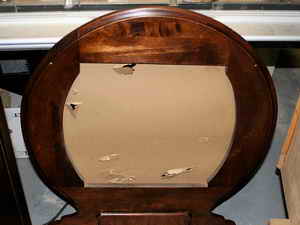
Anyway, what I really like about the thing is the mirror, which is circular and the silvering has darkened, and the glass has a slight ripple in it from its age. Everything looks better in it, because you can’t see so much detail. That becomes more important the older something or someone gets