


Offcuts: Dirt By: Don Heisz
I have worked on a great many construction projects over the years. I must say, I always prefer new construction. There are problems with renovations and additions that just don’t happen on a new building. When making something new, you are normally not dealing with the settled blunders of people who are long gone. Rather, you are dealing with the blunders of people still hanging around (or, at worst, your own blunders).
But there are more reasons to prefer new construction. I’m sure anyone who has ever worked on a new house knows the great feeling of being surrounded by all that fresh lumber and open air. It’s especially keen when the floor is covered with plywood and you’re well out of the ground. Not many people like working in the mud, really, so it’s always great to finally have wood under your feet.
It’s a similar feeling for anything new you build. The clean lumber has a nice fresh smell. The slate is clear and there’s only progress to be made. So, you roll up your sleeves and almost gleefully set in to get the work under way.
In stark contrast to that is the renovation project.
Every time I have worked on a renovation, I have remarked that there is nothing quite so disgustingly dirty as dealing with something that’s been sitting around for 50 years. In construction, it’s normal to end the day dirty (so much so, there’s a common joke about guys who manage to keep their shirts white all day long). But new construction dirt is clean dirt, if you know what I mean. It comes from the ground or it comes from using materials.
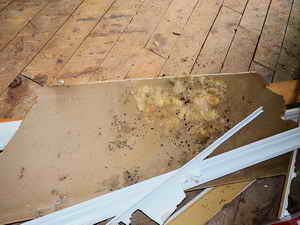
But picture the poor guy cutting through the drywall in his existing ceiling to install new lighting. He plunges the drywall saw in and cuts a nice neat circle. The cut away drywall falls to the floor in a shower of mouse droppings, half of which fall on his face.
I always wear a dust mask when I do any kind of work in my own house. I have allergies and, while no dog or cat has lived here since I moved in, I find that I react very badly when I disturb the dust that has settled in those hard to reach places. Without a mask, I am choking in no time.
Obviously, I use this as an excuse to drag my heels on my renovation projects. Experience has made me wary of touching anything that’s been sitting around for more than a few years. Horizontal surfaces are particularly bad because they get coated in a special kind of grease-infused dust that is eventually impossible to remove (unless you use oven cleaner or strong acid or fire).
The dirtiest places I have been have been renovations. One was a large building that was being gutted and turned into offices. I routinely looked like a coal miner by the end of the day on that one. Another was a subway station. That was a special one, because I had to spend time under the platform (forming the base of a column) where there was some special blend of dust made from 50 years of subway train brakes and whatever had fallen on (or jumped onto…) the tracks. I did find a nice pair of horn-rimmed glasses, there, though.
But dirtiest places aside, renovation is all about dealing with the garbage that you actually need to reuse in some way. My favourite phrase in the retrofit world has to be “patch and make good”. It’s found in the specifications for endless construction renovation projects. It specifically picks out the person who is dealing with whatever crappy situation has been made and says, “You touched it, you make sure it still works.”
Apart from dust and dirt and the occasional mess from some rodent or bug infestation, some materials that have been used in construction in the past seem to stay intact as long as they’re not touched. I was working with someone to put tiles back in a drop ceiling but they were breaking into pieces when we picked them up. I’ve seen insulation more or less completely compress upon itself under its own weight. I removed drywall from an exterior wall of my house to find the plastic sheet vapour barrier had become brittle and it actually crumbled when touched. Various kinds of foam board turn to dust after many years of varying temperature. Drywall seems to get more likely to break when you remove it and try to reinstall it. And of course wooden boards stop being anything like flat after a while. Nails also absolutely refuse to come out and boards being pulled off anything invariably splinter and turn into a billion toothpicks.
As much as I hate wasting perfectly good things, I would normally prefer to just throw away the old and broken and start over with the new, especially on commercial projects. But my own house is a different matter. When it comes to saving money by reusing the old junk that can be salvaged, I’m willing to put on the dust mask and deal with the dirt. As I’ve said before, not only would I need to pay for something new, I’d also need to pay to get the old garbage hauled away. And let’s face it, it’s cheaper to pay for soap than new materials.