


Offcuts: Do The Tools Make The Woodworker? By: Don Heisz
A few days ago at work, an electrician kept borrowing my hammer. “Please, please, just a second,” he’d say. Without waiting for any response, he’d take my hammer and go.
Aside from the fact that I don’t like having someone take my hammer from my workbelt, I actually use the thing almost all the time, although I don’t drive any nails. There’s always something I need to hit.
Some other guy said to the electrician, at one point, “You know, you’re supposed to have a hammer. Everyone here’s supposed to have a hammer.”
“Yes, yes, I know,” he said and tried to walk away with mine again.
I stopped him for a second and said, very seriously, “Do you know what they call a man without a hammer?”
“What?”
“A boy,” I said.
And that made the whole experience much more enjoyable.
Anyway, I wanted to mention that little interchange because, in a sense, it hits on a piece of truth. You’ve probably heard the expression, “The clothes make the man.” Now, most people assume that means a man really looks like a man when wearing nice clothes. But it’s really more along the lines of, if you dress a chimpanzee in a suit, he looks like George Burns playing a banker.
Sorry, some of you probably don’t know who George Burns was. Search engines can help with that condition.
As I was saying, the clothes make the man in a sense that they can make someone seem something other than they are. So, what about tools? Short of tools making someone a man, do they make someone a woodworker, for example?
The answer should clearly be “No.” But it’s not.
Guaranteed, if you take the tools away from a woodworker, you’re left with someone who can talk about doing things, say how to do things, want to do things, but is incapable of doing those things. Of course, the tools don’t take away your knowledge when they go.
But, in a way, they do.
Apart from the obvious tool accumulation that goes on for many people who engage in woodworking or a similar tool-based activity, there are those things which tools not only enable people to do, the tools likely embody a certain amount of knowledge. Using a tool properly is something that can be taught as completely separate from any real knowledge regarding how the tool performs its task or why it does what it does. Obviously, a hammer is not a good example. What a hammer does is easily known by extension of the idea of hitting something with a rock or even your fist. Driving nails with your fist is likely not a good idea, though.
Perhaps the main example would be simple jigs. My favourite example of the overblown woodworking jig is the dovetail jig. I have seen so many of these, each slightly different, ranging in complication. I think at least 50 different ones were used over the course of New Yankee Workshop alone.
Do you know what you do if you don’t have a dovetail jig? Well, normally, the one thing you don’t do is make dovetails.
So, this is an excuse for all you people who often feel you need to purchase the more esoteric devices, because you will not get that particular functionality without it. There are so many troublesome tasks made possible by certain tools, tasks that would not be done otherwise.
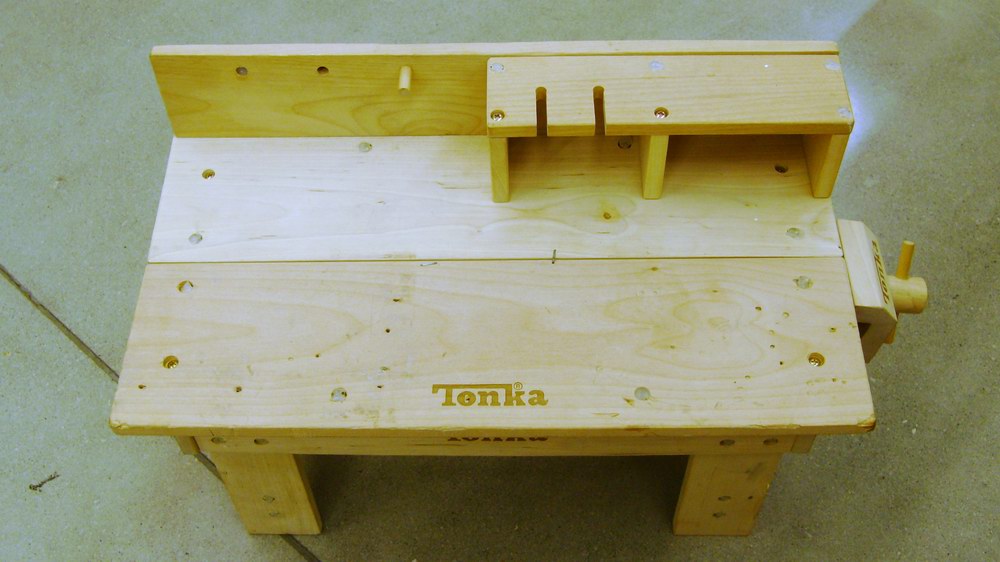
Most of us wish we had something like this when we were kids. It’s even got a vise.
Well, we know it’s not true. You can make dovetail joints without a jig. A pencil, combination square, saw, and chisel are all you need. And time. Oh, and effort. And when your pins and tails don’t line up, you need more wood.
Certainly tool or jig manufacturers would want you to believe that their tools and jigs are what make you capable and competent. Well, in order to be capable and competent using a router you need to actually have a router. Competence is not something you can just claim without having actually demonstrated it.
Of course, as the person in control of not only the tools and materials, but also of the very idea of the project itself, your knowledge extends beyond and encompasses everything represented by the tools you use. You need to know what tool to use for what task, you need to actually use it, and the end result is always something more than the use of a single particular tool.
Well, unless you have a workshop that has everything but sawdust.
That reminds me of what someone once said to me. It wasn’t about woodworking, though. He said, “If you don’t know what you’re doing but doing it anyway, make sure you stop at some point and try to figure out why you’re doing it. If you can quickly find a reason, it’s probably not true. If you can’t find a reason at all, you should probably stop. But if you think there might be a reason if you just keep doing it a little while longer, then you should be satisfied and keep going.”
That was obviously a paraphrase. Who could remember something that long? Anyway, that pearl of wisdom is free of charge for all those collecting tools and not yet using them. The day will come when you get to display your prowess in the workshop, make the family heirloom, hopefully not lop off your fingers, and make the world proud to have produced you.
Ok, that was an exaggeration. Except for the fingers part.