



Offcuts: The Annoyance of Progress By: Don Heisz
A couple of months ago, John and I were walking through Big Orange Building Supply Store when I stopped and stared at something unusual. We were there to get plywood and drywall to work on one of the rooms of his house (you may have seen something about this, already). Anyway, there was something there, in the lumber section, that was out of place. However, it perhaps should not have looked as out of place as it did.
What was it? What was it? Oh, tell us! You say.
It wasn’t anything too special and certainly nothing too special for a lumber store. It was rough cut maple in a couple of different widths, eight feet long.
Truthfully, we had to fight the urge to buy some. It was all very crooked. None of it was clear. It all looked like it had been culled from the inside of a couch (the source of lumber worse than you find in your average pallet). I declared they must be supplying a furniture manufacturer and so, we retreated empty handed.
Apart from the obvious allure of cheap hardwood, what possible reasons would there be to want to get something like that? The desire was almost so great as to be irresistible. And I think it has to do with a forced rarity of such stock in that particular kind place, where that place has largely taken over the very idea of what’s available to buy.
Here’s a rather short anecdote. I recall nailing down a floor when I was very young, perhaps eight or nine, on something my father was making. The floor wasn’t plywood or OSB, it was T&G SPF board. What’s that? What’s that? three or four of you ask. It’s tongue-and-groove board made from softwood (spruce, pine, or fur). And it was a standard thing to use for floors or shed walls or whatever.
Anyway, my father was mildly surprised when I told him around 15 years ago that I couldn’t actually buy any T&G boards in the Big Orange or Big Blue Building Supply stores.
Oh, go to a lumber yard, where they have all that stuff outside, say one or two of you older people who remember when lumber dwelt in yards. Well, the fact is I looked in a couple of those and they didn’t have any, either.
Why not?
It’s been replaced. Progress, in its most annoying form, has dictated that such stuff was not good for making floors or shed walls or anything at all. Progress has instead dictated that you use sheet material, which stacks more neatly on the Box Store Floor, keeps in the rain a whole lot better in the fabled lumber yard of yore, and on average costs more for you to buy, which makes Big Building Supply Stores happy, and is much faster to use, which makes you happy. Everybody is happy.
Unless you happen to want some boards. You know, actual wood.
Oh, go buy some finger-jointed, V-groove, pre-sanded, six-foot-lengths of pine “flooring”.
Hey! You know what the stupidest thing ever is? Putting something with a V-groove on a floor. That? Who would do something like that! Really! Think about it.
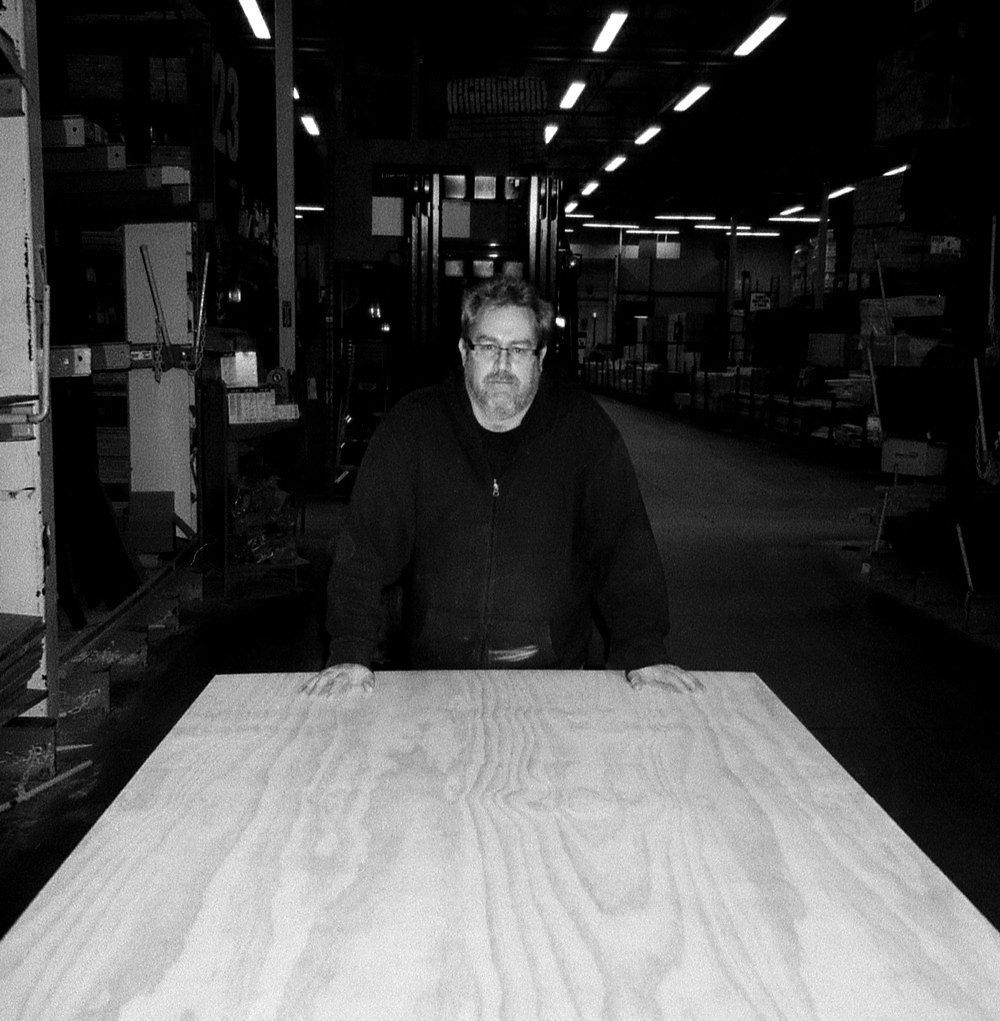
John pushing the lumber cart (image used without permission).
Anyway, I know everything that ever was available is still available somewhere. I see new barns being built using the same methods and materials they used in the barn under it, the one that just fell down, because it wasn’t built well. Ah, that’s not fair. These barns are built well-enough. They are generally monstrous things that have to withstand the elements and they do manage to do that for quite a while. But, you know, there are less of them every year. I’ve been seeing more and more hanger-type installations replacing them. Those buildings aren’t as cheap, but I think they come in kits, and you don’t have to assemble the mythological team of community farmers to raise them. That’s a good thing, since more and more farms don’t actually have a farmer, anymore.
Ah, who cares? The corn still tastes great at the end of summer.
Anyway, I have previously gone and tried to get softwood boards because I would like to use them for various things. Probably the best most recent source for actual boards was a mill John and I found in a town in the great frozen north of Ontario. John bought enough pine to do the floor of part of his house (not his current house). And, apart from a minor mishap which told us the value of securing the load, we managed to get all of that stuff back to the warmer climate of the great frozen south of Ontario.
Why did we have to drive so far away to get that wood? Simple. We had no idea where to get it and we happened to randomly see this place. These places, they don’t know that the world has changed. They still live according to wall-clocks and their management keeps a bottle of Canadian Club in the desk drawer for those extra-long afternoons (that’d be all of them). Seriously, when you walk through the door to the sales desk of this place in the middle of nowhere, you have effectively walked back to 1970. I think there may have been a calendar on the wall advertising the Ford Pinto.
The upshot is, these people don’t know or don’t care about no stinkin’ internet. They therefore don’t realize that no one knows they exist, anymore.
They may wonder why so few people walk in off the street.
But it doesn’t matter. Turns out they do a booming trade providing the same boards to Big Multicoloured Building Supply store. Well, they have to cut some V-grooves in them, first. You know, to make the wood good and useless and all.
Anyway, that place isn’t alone. But it’s getting there. Ten years ago, searching the internet for lumber suppliers informed you of absolutely nothing. According to the internet, wood was no longer for sale. A few places are actually visible online, now, though.
Let me get to the point of what I was saying here. It’s not about the availability of various types of things. You can go spend a big piece of time trying to find the obscure things you want. Even if you think they should not be obscure, they are now. But you can still find them. T&G boards? yes, they’re available, if you drive far enough. Classic 70s Oak Panelling? I’ve actually seen it lurking in an old hardware store. Whatever you want, you can get, but it may cost more. You think it should cost less, and it would if it was still the go-to material for a job. But the go-to material has been upgraded to more expensive and easier to use.
That’s progress. It’s annoying, but that’s how that particular ball rolls. It’s to benefit everyone. And the fact is, as time passes, fewer people will come looking for what used to be available, because they never knew it existed. It turns out that so many decisions have already been made for you before you even get out of bed. It’s comforting, isn’t it?