



Offcuts: Plywood and The Heat Wave By: Don Heisz
So, it’s been very hot.
This is supposed to be a northern country and not supposed to get that hot. That’s the rumour I’ve heard about it, anyway.
But the fact is, it gets very cold in the winter and so it costs a lot to keep the house warm, then it gets very hot in the summer and it costs a lot to keep the house cool. My house is no exception. However, I don’t have central air, I have hot water radiators for heat. And I have only two window-mount air conditioners.
I was asked yesterday, actually, what the “conditioning” in air conditioning is. That’s a good question. It’s not like it permanently changes the air to behave a different way, the way you condition a dog to not mess up the carpet.
My window-mount air conditioners, I must say, do a decent job conditioning the air in front of them. A few feet away, maybe not so much. However, they do suck much of the humidity out of the air.
They are also rather ingeniously mounted. When I moved into this house, even though it was December, two air conditioners were still languishing in windows, one in the living room, the other in the master bedroom. They were not exactly good examples of installations. For example, the one in the master bedroom was mostly held in place by duct tape. That was failing, of course, since duct tape fails 95% of the time, and snow was actually blowing in around the unit. The air conditioners had to stay in the windows for several days before I discovered where the missing sliding windows were hidden (behind some bizarre huge shelf made from 2x3s in the basement. I think it was a wood rack.).
The windows were not very good on that (the north) side of the house, and I replaced them not long after moving in. I installed four-foot wide vinyl sliding windows. When it came time to reinstall the air conditioning units, I was faced with the age-old dilemma of how to get it to stay in there and actually cover up the empty space.
The kits (not that I had a kit with these duct-taped-into-cardboard units) that come with these things are really meant for single- or double-hung windows (the up and down variety). Even then, many people would end up finishing off the install by applying a good portion of the roll of duct tape.
My solution was to take the unit outside to the saw horses. I had a piece of 5/8 plywood that had been out on the ground for a year. I cut a piece the same size as one of the sliding windows. I cut a hole it the exact right fit for the air conditioner. Then I build up around the edges with thin (quarter-inch) plywood that actually fell off the house earlier that year (maybe I pulled it off). That made the plywood panel the same thickness as my sliding windows. So, after framing around the air-conditioner opening and positively screwing the unit in place, I carried the whole thing into the house, took out the single sliding window, and replaced it with this plywood that had the air conditioner in it.
It’s happily running right now, sucking up the dollar bills.
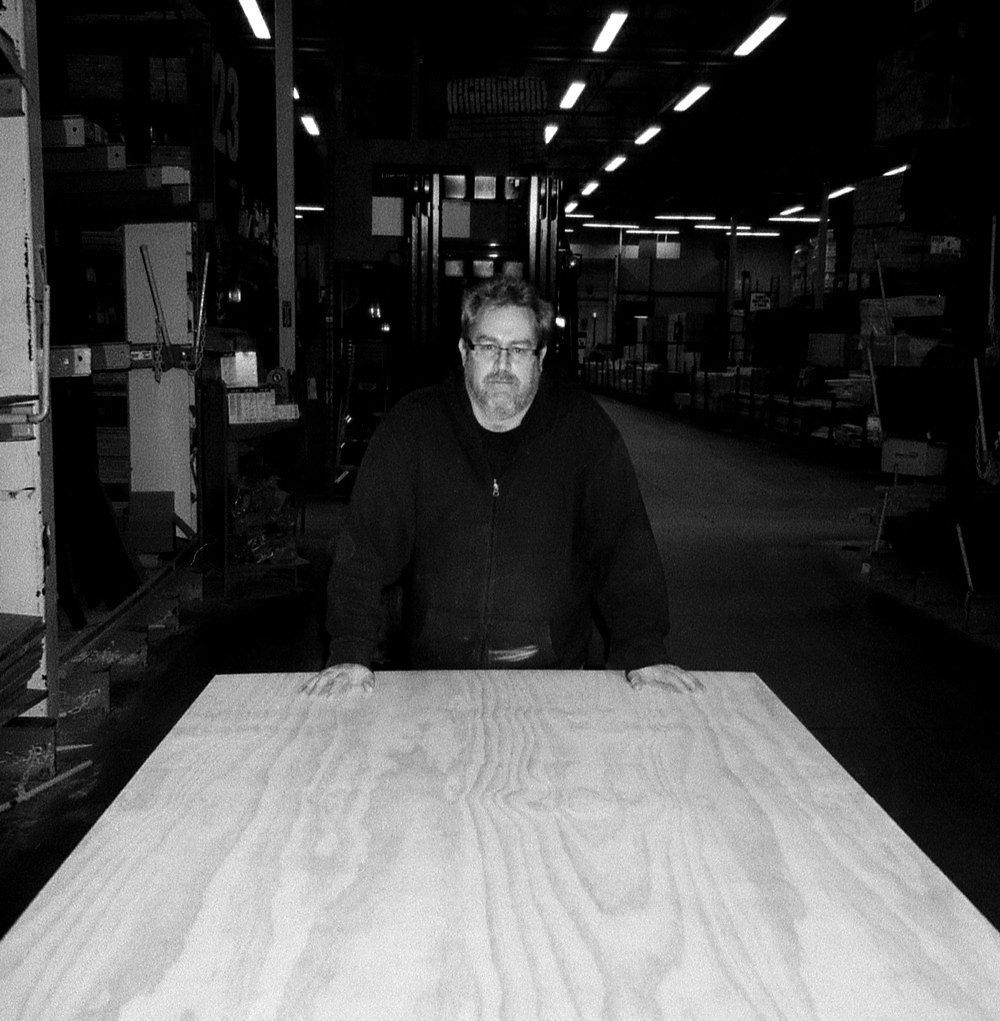
The moral of this story is that plywood is the most useful of building materials.
You may not believe it, but it’s true. If you need to make something or do something or have something, and if you have plywood, you are 85% of the way there. Plywood truly already has that much of the work done for you.
Think about it. If you want to make a table, you will probably get some nice boards, perhaps 5/4 stock, plane them and joint them, glue them together, sand that down, square it up nicely, perhaps add the bread-board edge, round-over the corners, scrape it smooth. After all that work, what do you have? Why, something inferior to a sheet of plywood!
Grab your plywood. Grab some edge banding. Cut the plywood to the size you need for your table. Do a nice radius at the corners, maybe. Edge band it. (If you’re fancy, you can get some of the vinyl edging that slips into a routed groove.) Apply the finish and start using it.
Of course, I’m not being completely serious. But if you need a result and don’t have the time or inclination to mess around with solid wood, plywood is your very best friend.