



Offcuts: Forgotten Skills (or maybe never known) By: Don Heisz
They sure don’t make stuff like they used to. That’s the saying, isn’t it? That’s what people say whenever they come across a fault in a building or piece of furniture or some other thing.
The response is, of course they don’t.
I was talking to a guy a few days ago. He was putting a ceiling in a corridor in a new building. He was complaining about how the building was more than 2 inches out of level from one end to the other. That means one corner was over 2 inches higher than the other corner. (Believe it or not, you can’t see this sort of thing until the guy shows up to put the ceiling in.)
In my old high school gymnasium, by the time they condemned the building, you could place a basketball in one corner and watch it speed up as it rolled to the opposite corner. But that place was sinking into a swamp.
Built in 1973. They don’t build them like they used to.
But, to be fair, that place was actually level when it was finished. It was likely laid out with a water level and transit.
A water level is a fine piece of technology. For those who don’t know, it’s essentially a clear tube filled with water. Make sure there are no air bubbles and it is actually incapable of being wrong.
A laser level, however, suffers from a couple of problems, one of which is calibration error. But even if it’s perfectly calibrated, the fact remains the receiving sensor is held by a person. I’ve seen many guys holding these and, apparently, no one knows how to hold a rod plumb.
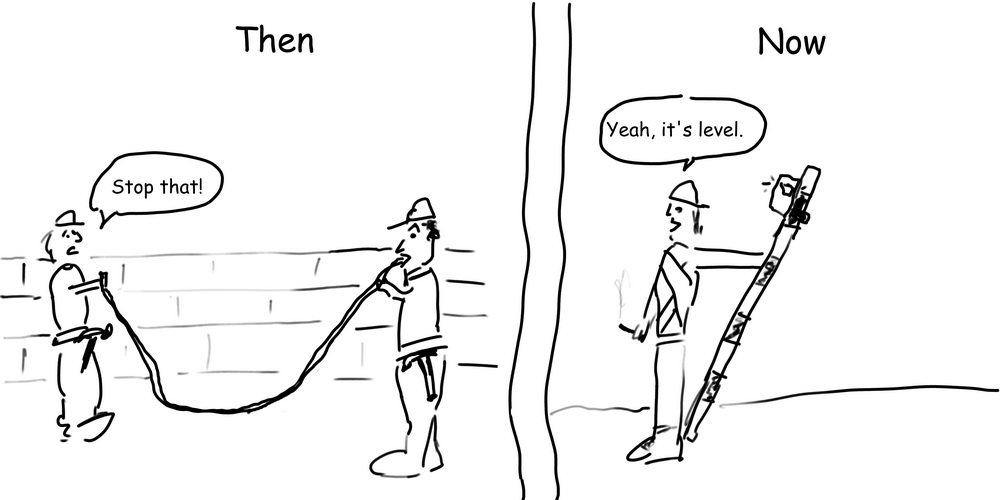
Anyway, I wasn’t interested in speaking solely about laying out buildings. I wanted to draw attention to a fact that arises when discussing such things. The technology for making things is, for the most part, superior to what there was before, even in the not-so-distant past. A laser level, in the example I’ve provided, if calibrated and used properly, will give excellent results. Perhaps not as perfect as a water level but certainly faster and should be good enough.
So, they don’t build buildings like they used to. But they don’t make furniture like they used to, either. Apart from mass-produced, extra-cheap garbage, people also don’t make handmade furniture the way they used to. Good or bad, they don’t do it the same way. Quite often, the end result is a higher quality piece of furniture than what could have been made 100 years ago, simply because of the use of better glues and fasteners. But the use of better glues and fasteners itself actually removes skills that were once needed by a craftsman to deal with poor glue and fasteners.
The dovetail is a prime example of something that is more or less never needed anywhere anymore. A butt joint that’s glued and nailed will, in most circumstances, do just as well. A pencil can draw on the tails afterward.
No, no, make the real dovetails. So, break out the router and the template and spend two hours messing up a dozen pieces of wood before you get it right, since it’s something you only do once or twice a year.
That’s not dovetails, no. Get yourself a good sharp back saw and a nice sharp half-inch chisel. First you make the pins, then you use them to mark the tails. Takes more time. Involves more skill. And you likely won’t mess up any pieces of wood. The great thing is, sloppy pins in sloppy tails don’t actually look that bad.
Jump back 100 years, the guy making the drawers could pound out 100 perfect dovetails in an afternoon. He could probably do it dead drunk, too, with the absent fingers to show for it.
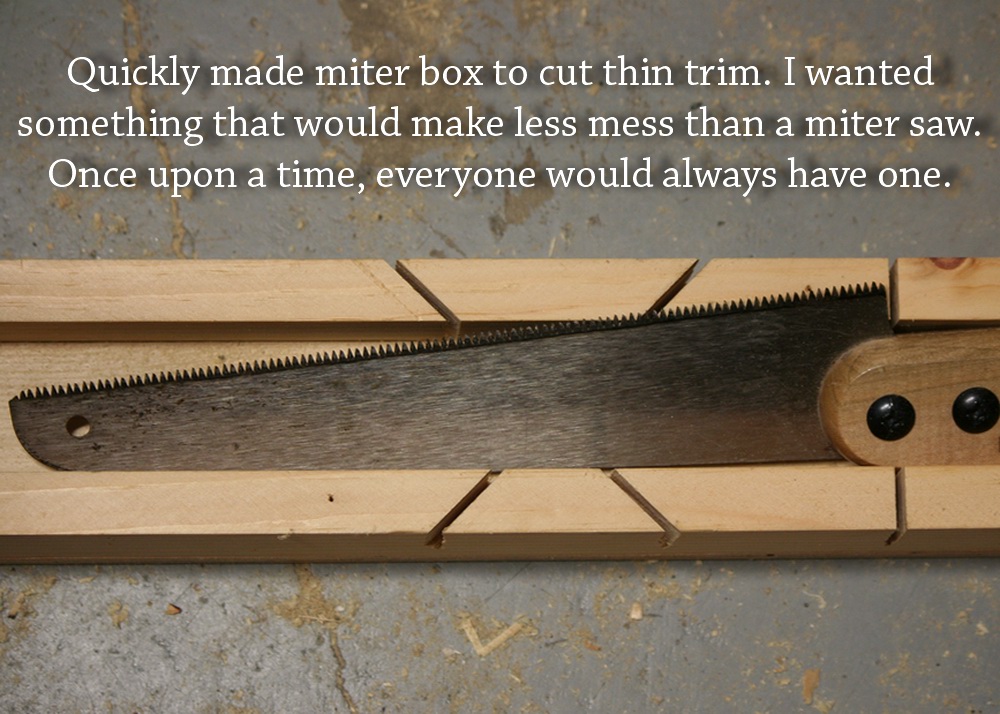
Anyway, the point of what I’m saying is that if you do that now, you’re not doing it the way they used to, you’re pretending to do it the way they used to. Most people will be willing to use the sharp saw and sharp chisel to make their rustic dovetails but very few will be willing to spend an hour each day sharpening their tools. Furthermore, very few would have any idea how to sharpen their tools.
The normal way to sharpen tools is now to go buy new tools.
In terms of quality of workmanship, they don’t build them like they used to because too many once basic skills have been lost. While there are many skilled craftsmen in the world who still have and use these basic skills, the majority of people engaged in any kind of making have indeed never learned any of them.
A long time ago, in my high school woodshop class, the instructor taught us how to cut a half-lap joint using a saw and a chisel.
Yesterday, I saw a home-made gate where the corners were joined with truss plates.
Shed a tear.