



Offcuts: Rehabilitating Doors By: Don Heisz
In my house, all but one of the interior doors are original early 1970s plywood slabs. They are as hollow as Cracker Jack boxes and light as feathers. For the most part, they still sport their original dark varnished look, but they have, of course, undergone some torture since their initial installation, and every scratch, dent, and hole is perfectly visible.
One of these original doors, however, is a beautiful specimen of homeowner ingenuity. To deal with the staples, scratches, stickers, and dents in the door, someone decided to paint it the same colour as the walls of the room. Or maybe there was an accident with the brush or roller and some paint got on the door and the thought was, “Well, may as well paint that, too.” That apparently went for everything: in that room, the walls, moulding, door, light switch, electrical outlets – all got the same light brown paint job. Being in there is a bit depressing, in fact. Memories of the outside world begin to fade after a while.
I am, now and always, in the process of trying to fix various parts of the house. I am at the point where I can actually replace at least some of the doors with new ones. But new doors cost more than doors that are already here. I don’t want to spend money unless I have to and so I see these doors as not only redeemable but also as a bit of a challenge. I think I can make them better.
They have problems, of course. Almost every door in the house was hanging off its hinges so I had to glue plugs into the screw holes and redrive the screws as soon as I moved in. That made things a bit better.
Then I had to plane a few doors that were rubbing at the top because of a different problem this house has, namely the fact that the middle of it sank due to insufficient support throughout. Some people would call this “settling”. I doubt a house should “settle” 2 inches in the middle – I’d be more likely to call that “unsettling”. I have since jacked up the house and added more support.
My method for fixing the doors to make them look (not new) better is to remove them, fill the holes, and sand the whole thing down. Then I prime and sand again and then finish coat. The doors genuinely look way better after that.
Of course, they’re not six panel doors. They’re not solid wood and glistening with a hand-rubbed finish. Frankly, I don’t want them to be. I could spend my time and quite a bit of money making such doors but I find it difficult to justify. I know my kids don’t care if the door is solid wood or solid polystyrene. They just want it to close behind them.
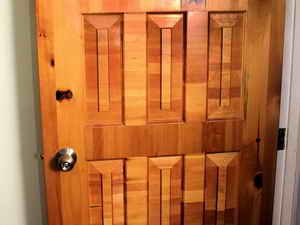
And not all solid wood doors are particularly good, anyway. The only door in my house that is not original issue is the door to the master bedroom. The previous owner of the house must have though he deserved something real distinctive so he got himself a solid pine door with not six but 12 panels in it. He then gave it a good healthy coat of orange shellac and that’s how it stayed until I discovered it.
That may not seem bad at all. Who doesn’t like a solid pine door? Who doesn’t like raised panels? Who doesn’t like orange shellac? Well, the shellac isn’t quite the right colour, for there or for any of the other places it was slathered in this house. Two walls were covered with 4-inch tongue and groove wood paneling that was then doused in shellac. Perhaps it’s good in the hunting club, the yacht club, the East India Company bar, but it’s not really good in a bedroom. Or I don’t think it is.
But back to the door. The problem isn’t the design of the door, nor is it that it’s made of wood. I don’t even consider the finish much of a problem (although a bit of sanding could have helped at some point). The door itself is wrong. I’ve never seen anything quite like it before, actually. Every detail of its construction is incorrect. The grain in the raised panels runs horizontally. The grain in the muntins runs horizontally. And the grain in the rails runs vertically. The only place where the grain runs properly is in the stiles. The wood itself is glued-up tiny strips. There are knots – some of which are actually on the edges of the glued strips, so actually half a knot glued to clear wood.
Some may wonder, “What’s the big deal about getting all the grain direction backward? Paint it and get over it.” Well, it turns out that having the grain run vertically in the rails causes the door to change size rather drastically when the seasons change. It’s much more humid in here in the summer and the door fits in the opening fairly well. By the end of winter, however, it no longer latches. It shrinks almost half an inch, which is significant for something that’s not thirty inches wide.
So perhaps I will make a new door for there. Or perhaps I will buy one. One thing is certain, though – I won’t be trying to rehabilitate that door. Some things just can’t be fixed.