



Offcuts: Tiny Table By: Don Heisz
A few days ago, I was in one of my favourite thrift stores. I can easily say I frequent the place, since I pass by there every second day. I almost never buy anything, but I have purchased some good things in the past. They don’t sell clothes there, by the way; it’s not that kind of thrift store. They do, however, sell tools.
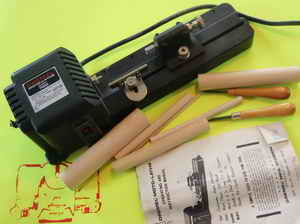
I was lucky enough to find a micro-lathe for $4. It doesn’t matter to me that it is actually 40 years old. I’m older than that.
I, of course, ecstatically bought it. I made no attempt to haggle. At the very least, I could begin turning my own toothpicks from the piles of wood in my yard.
I may have mentioned before that I was thinking about making dollhouse furniture. I do have a daughter and I’m sure she would like a dollhouse at some point, but that’s not the reason to make dollhouse furniture. No, the reason to make dollhouse furniture is because you want to make furniture. Perhaps you have no place to put it when it’s done and no one to sell it to, you still want to make it.
And, of course, you also want to use your tools.
There is something compelling about getting a new tool. It has way more psychological power over you than an old tool does. Tools that have been sitting around, the old stand-bys, they don’t really inspire any longer. So, to make the building process more fun and exciting, go buy a 56-hundred-dollar thickness planer.
Ok, maybe not that expensive a tool.
Anyway, in a great dash of eagerness to find out how well it worked, I set it up and got started making a few tiny table legs. I discovered that everything that originally came with the machine was in the box, except for a couple of chisels. I, however, already have a number of mini carving chisels that can do well enough to cut on the lathe.
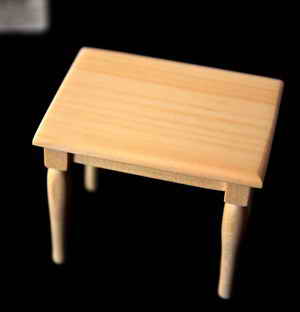
Within a few minutes, I had my 4 table legs made and got started on making the other pieces. I was pleased with the performance of my virtual antique. It has a few idiosyncrasies but, once you realize what the problems are, it’s easy to work around them. For instance, because it’s a high speed/low power machine, the stock cannot be held too tightly or it will stop the motor. Not insurmountable for a machine that will accept stock 3/8 of an inch thick.
My table took a little bit of work to assemble. I used a dowel-assembly to put it together. For dowels, I used round toothpicks, snapped off to appropriate lengths. Regular wood glue did the trick. I also glued the top on. I realize that is a big mistake for table-making but my goal in this instance was to have a finished item in my hand.
So, after a few minutes, my table was all set. Tiny amounts of glue set very quickly, it seems. The table is 2.5 inches high and 3.5 inches long. I was going for a 1:12 scale on the construction, but really ended up just going off the top of my head. The top is 3/16 of an inch thick – at 1:12, that would be a real table-top of over 2 inches thick.
I’m actually already starting to think about my next furniture project. No time to worry about the vagaries of the precision of details according to scale, I need chairs to accompany the table. Perhaps some nice shaker-inspired ones. Good square cuts may be desirable. Where can I get a tablesaw with a 1-inch blade?