



Offcuts: The Amazing Tomato Paste Can Wideangle Pinhole Camera By: Don Heisz
Everyone has hobbies. I imagine many people reading this have woodworking as a hobby. Perhaps some of you have collecting old tools as a hobby. Perhaps many of you do woodworking with old tools you collect. Or perhaps many of you read weird things on the internet as a hobby (I think maybe all of us do that, now.
One of my hobbies is collecting and using old cameras. While I am aware that everyone is in the digital age and is supposed to be buying the latest dodad, I’m also aware that most people consider assembling flat-pack furniture a great feat of craftsmanship.
Anyway, perhaps some of you have heard of pinhole cameras. They are most famously promoted to grade-school children to use to view solar eclipses. That model is a cardboard box with a pinhole at one end, a viewing hole at the other, and a paper viewscreen somewhere in the middle. A pinhole camera has the wonderful characteristic of having everything in focus, no matter what the distance. However, the images are typically not very sharp.
I find most things kind of boring after a while. And, while it would be nice to make a straighforward pinhole camera that would take a relatively normal photo, I decided to experiment and make one that would capture a very wide angle. I used a tomato paste can and made up some parts from wood. Where the film goes (a normal piece of 35mm film, cut 2 inches long) is curved, which increases both the angle of view and the brightness of the image at the outside edges. You can see the camera below.
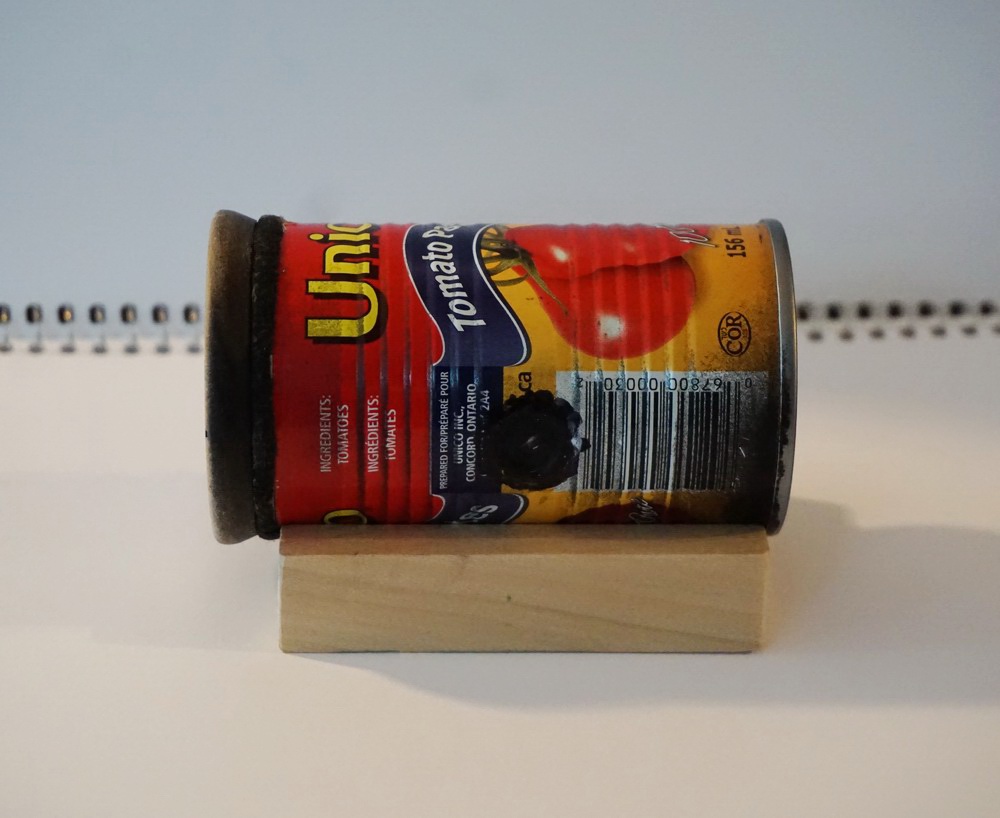
The black spot in the middle is a very thin piece of aluminum with a very tiny hole in it. Normally, this is covered up with a piece of electrical tape, which acts as a shutter.
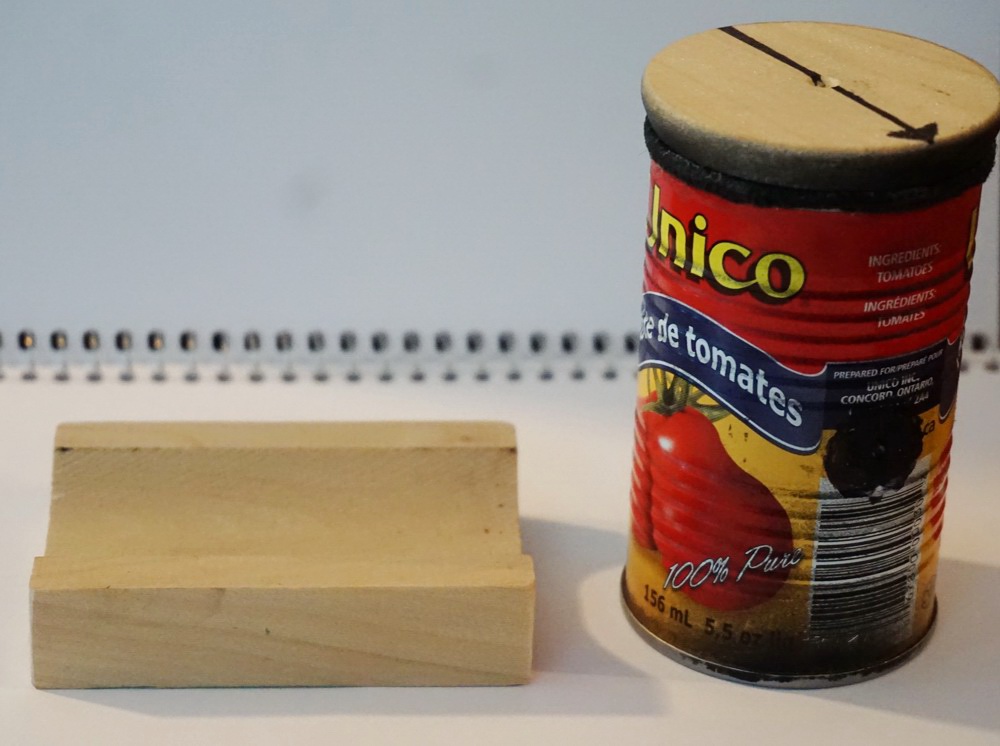
The stand was made on the tablesaw, including the sculpted curve. The cover of the can has an arrow which indicates where to point it to get the image you want. A bit less accurate than an SLR.
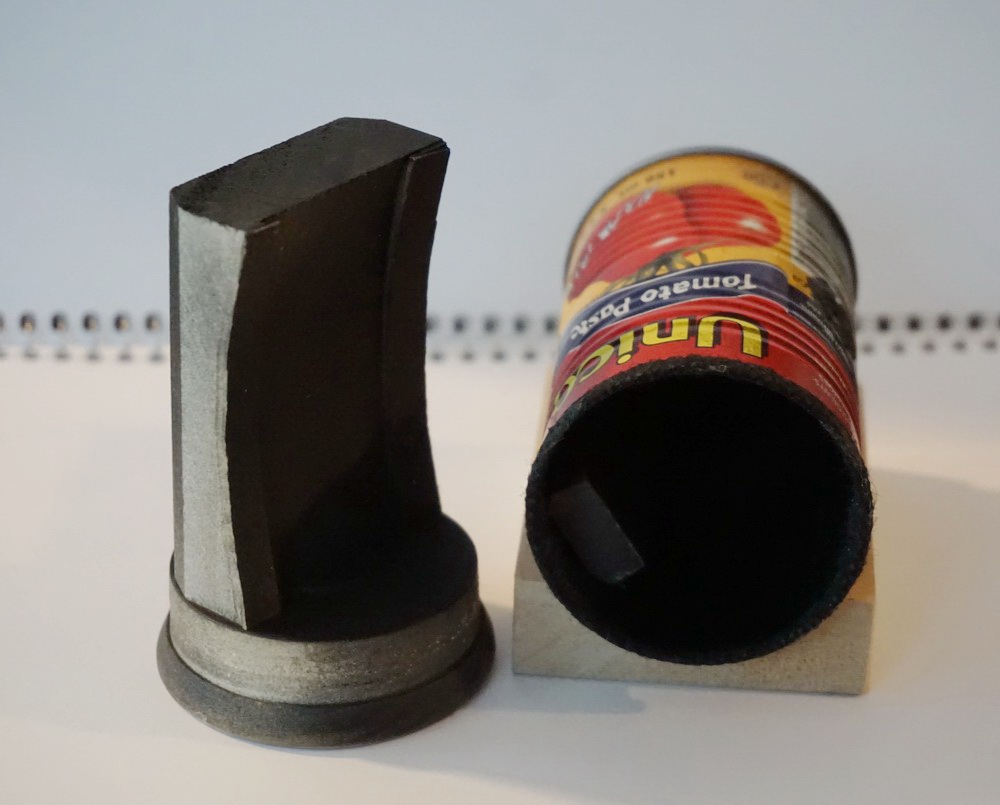
Here, you can see the inner workings. The inside of the can is painted flat black to eliminate reflections. The film plane curve was made on the table saw and is attached to a piece turned on the lathe. A block is screwed inside the camera to ensure the film is oriented correctly.
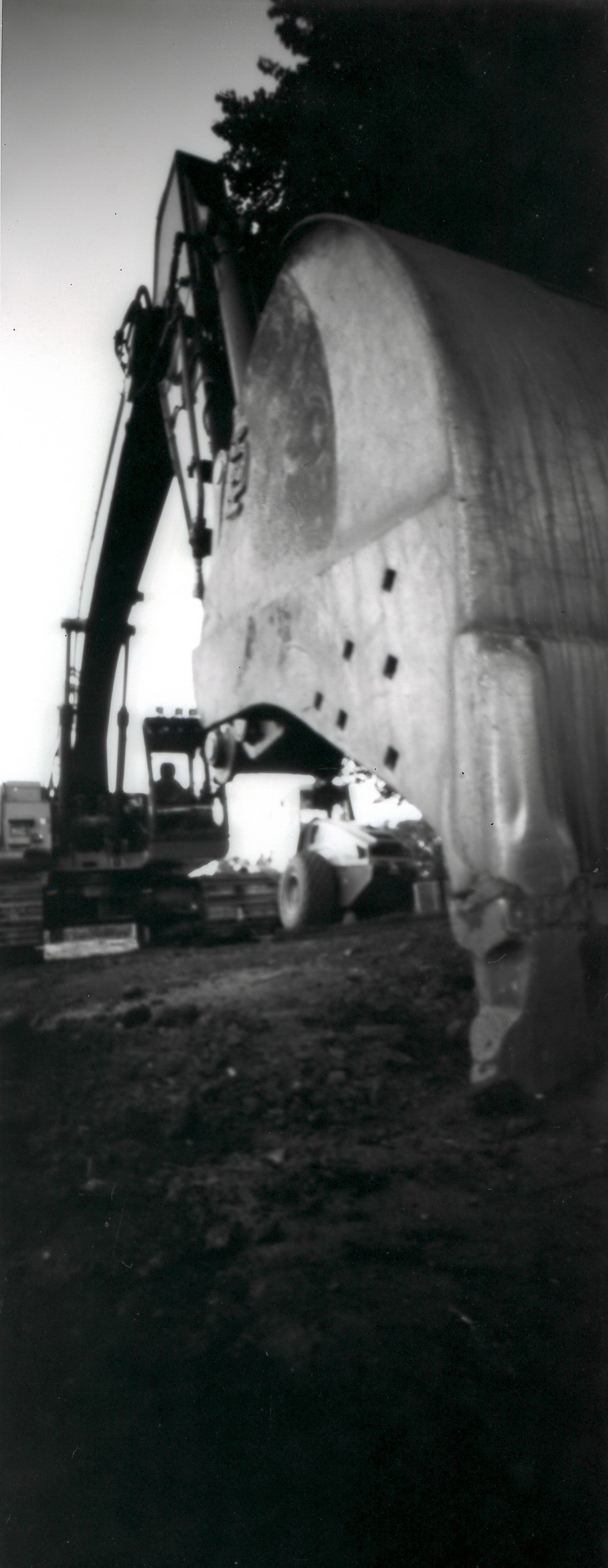
There’s not really much more to say about it other than it was an interesting thing to make. In order to take advantage of such a thing, however, you need to be able to develop film and somehow get the image from it. The following photo was taken of a machine currently parked on my street (the road is all torn up). The image is not sharp, but everything is in focus, and the image itself is quite bizarre, with the bucket in the foreground and the rest of the machine appearing far back in the distance. That, of course, is the result of the wide angle. I thing this particular tomato paste can captures around 165 degrees.
That might be a bit big to see all at once.