



Offcuts: Imitation Tools By: Don Heisz
Sitting in a corner of my basement workshop, under enough dust to make an elephant sneeze, is an old portable tablesaw I bought to use for work. At the time, I had a lot of work to do that need a tablesaw on site. Nothing can quite take its place, after all.
At that time, I didn’t have many tools of my own, nor was I particularly interested in getting them. I lived in an apartment and had no room for tools or materials. That of course has changed and I now have no room because of tools and materials.
I remember looking around the store at the tablesaws they had there. The best one, from what I could tell, was a very well-known and respected brand. The second best was also a well-known and respected brand. I didn’t get either of those, because they cost over twice as much as the very worst example in the room: the store brand tablesaw.
It’s a phenomenon that is true of all things. Practically whatever you can think of, there is the more recognizable, branded version, manufactured by a company that has been manufacturing that thing since your great grandfather was rolling hoops in the alley. But there are also a multitude of knock-offs, copies, rough imitations, manufactured by some unidentified company. They generally only say, “Imported by Importer X for Company Y”. We’ll get back to that.
Anyway, I have had a number of store-branded or generic tools over the years. This tablesaw was not my first. I think the very first store-brand tool I bought was a battery-operated drill. To be truthful, I can’t assess its relative quality that well, since battery drills were constantly getting better at that time, and they all ranged in the useless-to-almost-completely-useless range. My wrist with a scratch awl in my hand had more power than that drill.
I have had more success with generic tools like screwdrivers, since I tend to lose them before they get any real amount of use. I’m sure there is a small country somewhere in the world populated only by lost standard and Phillips screwdrivers. They will live to a ripe old age due to never being used.
Actually, I can state with a fair amount of certainty that I have lost well over a dozen such screwdrivers in the mud outside of new construction while carrying things to or from my car. So, they’re mostly under the parking lot.
Anyway, I did buy a nice long Phillips #2 screwdriver and managed to keep it until it wore out. That took not very long at all. My main line of work then, and now, was installing doors and the various things that attach to them. I was using that screwdriver to hand-tighten small screws that would easily strip. Well, the screwdriver actually stripped. No great amount of force was required. So, it turned into a lousy centre-punch. I think I actually threw that one out into the mud.
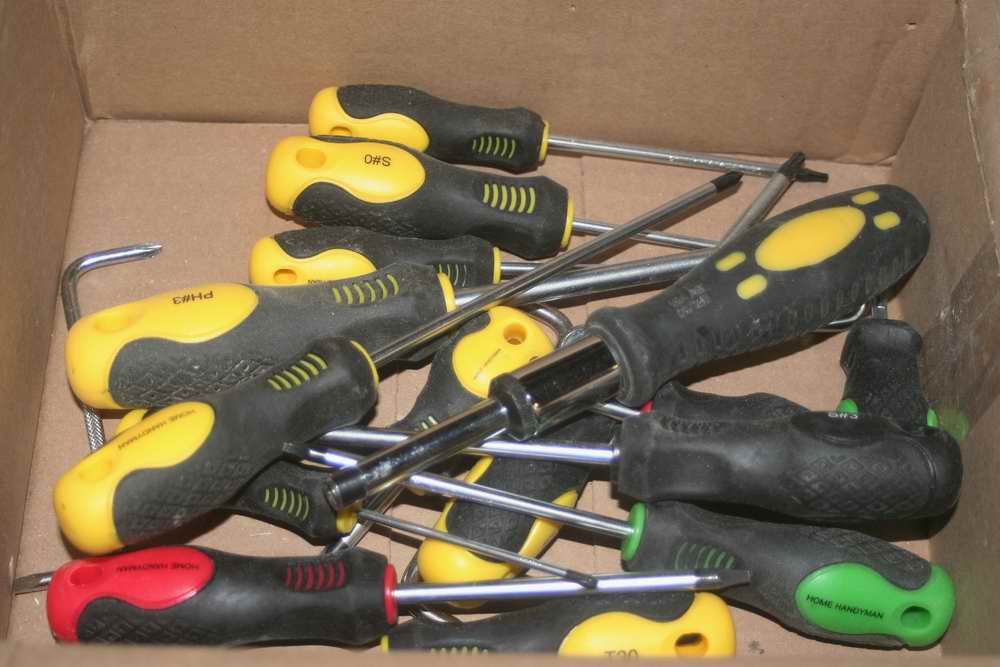
Above you see an assortment of cheap screwdrivers that came in a set. I have almost no use for these ones – that’s why I know where they are.
Incidentally, I have had good, brand-name screwdrivers. But the Phillips one ended up falling out of my pouch to never be seen again and the standard one was left in a hallways ceiling of a building the very last day I was there. I imagine it’s still there.
Anyway, I was talking about a tablesaw.
So, I picked out the cheapest saw in the store and set it to work. To its credit, it had a decent blade in it. And the mechanics of the motor carriage were absolutely fine. It was not very powerful, but I wasn’t going to be ripping timbres with it.
It was loud, though. Although the motor looked identical to the one in my circular saw, the plastic housing of the “table” seemed to amplify the noise to an unbearable level. The thing also blew dust everywhere. I remember when I set it up on one job site, I taped over as many holes as I could in an attempt to control the dust, but it didn’t work. I think the air-flow from the motor was blowing the dust directly off the blade as it cut.
But those are trivial matters. I can live with that. I certainly could at the time, since when you’re young you don’t believe that the tool you’re using is making you deaf while also suffocating you. No, the single worst aspect of that saw was the fence.
At no point would the fence ever hold itself at 90 degrees to the table. The first times I used the saw, the cuts were binding, so I checked how the fence met the table, and that seemed to be right. But as soon as you attempted to clamp the fence, it shifted closer to the blade at the other end. So, there is an adjustment screw. Or is there? No, not really. I took to putting the fence in place, then clamping while holding the other end where I wanted it with my other hand.
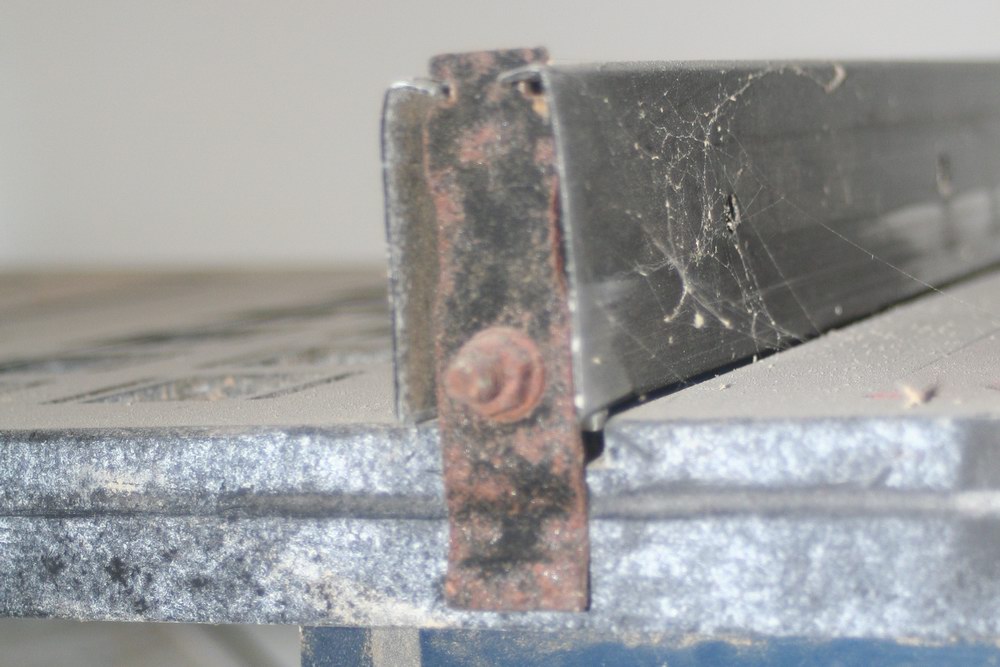
Here is a rather blurry detail of the end of the fence. Fitting, since the end of the fence is a blurry detail, anyway. The cobwebs are in better condition.
That worked for a little while, but the fence very soon started to slip off its position. So, repeated cuts were impossible without checking the fence between each cut. I got into the habit of using my measuring tape to check the distance between the blade and the fence every time I made a cut.
Maybe that’s just good practice, anyway. Quite a few years later, I was helping someone install his kitchen cabinets and a filler panel needed to be cut on a tablesaw that he had borrowed from someone else. That tablesaw had the same junk characteristic as my old one, so I immediately pulled out the tape and set the fence using that. The measuring scale on that tablesaw was off by a quarter inch.
The fence woes continued. John and I had to do some work once and I pulled the saw out of retirement to bring with us. John spent some time trying to get the fence to stay where it should but it was a losing battle. We used it as much as we had to and it’s been retired ever since. (Actually, John used it in a video quite some time ago demonstrating what would happen if the saw blade caught the sleeve of his shirt.)
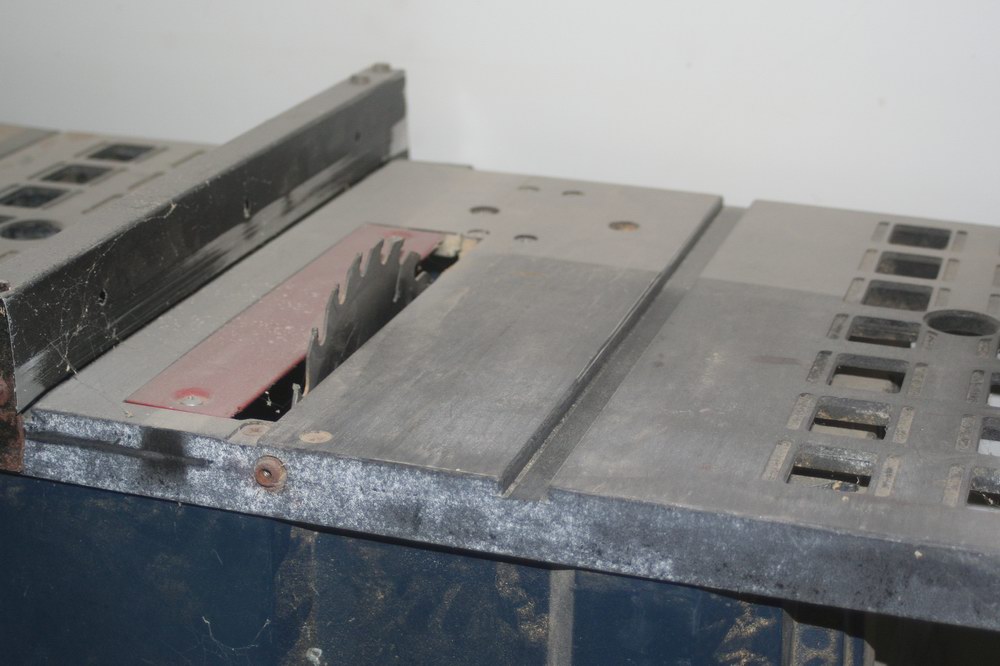
Behold the beauty. The fence has paint won off unevenly because it’s not actually flat.
So, to whom do you address your concerns about this tool? Do you go back to the store and complain to the guy in the vest who sold it to you? He doesn’t care. Perhaps you should escalate that and try to talk to someone higher at the store. He doesn’t know what you’re talking about, he only places orders. The buyer for the chain only ever tells Importer X to supply store-branded tablesaws. Talk to Importer X and he’ll say that he supplies what Company Y wants and gets it from a “number” of foreign manufacturers. He’ll forward your complain.
Ah, no one would bother. These things are so cheap, you expect them to be faulty, you don’t return them, you use a few time and discard.
Is that good?
Quality is something we would all look for in the tools we purchase. But economy often plays the winning card. And the fact is, at first glance, you often can’t tell the difference between the original manufacturer’s fully researched, designed, tested, and marketed product and the cheap, superficial, marginally functional, and unadvertised knock off sitting beside it. But the difference is real. It’s real if only in the fact that the store-brand tool never needed to pay for any advertising. It’s advertising is sitting right next to it, in the form of the thing it’s imitating. And the difference in cost will almost always shine through, especially for the inexperienced.